

| Lead Manager: | Neighbourhood Manager |
| Responsible Senior Manager: | Assistant Director of Housing |
| Approved By: | Customer Committee |
| Date Approved: | June 2024 |
| Date for Review: | June 2027 |
| Replaces Previous Version: | N/A |
| Linked Policies: | ASB Policy, Vulnerable Persons Policy, Reasonable Adjustments Policy, Responsive Repairs Policy, Safeguarding Policies |
1.Introduction
1.1 Shropshire Towns and Rural Housing (STAR) is an Arms’ Length Management Organisation; (ALMO) and manages the stock on behalf of Shropshire Council. It is responsible for the Council’s housing stock including the letting, maintenance, and management of its properties and estates.
1.2 This policy sets out the approach to be adopted by Shropshire Towns and Rural Housing (STAR) in relation to all customers affected by hoarding to ensure that all are treated fairly and receive adequate support and guidance to resolve any issues or live safely with their hoarding condition.
1.3 Hoarding is the persistent collecting of goods, objects or animals and being unable to discard of such possessions when the quantity has become excessive. Hoarding can vary from mild to severe cases whereby it may not impact a person’s life at all or could seriously affect their functioning on a day-to-day basis.
1.4 Hoarding is a recognised mental health condition which can affect:
- The health and safety of our customers in their homes
- The ability and actions needed to be taken by STAR to ensure it meets its building safety compliance obligations.
- The health and safety of their neighbours or adjacent properties
- The condition and value of the properties that STAR own and rent.
1.5 STAR recognises the reduction to social care and mental health budgets has had an impact on our statutory partners responses. To address this and the growing awareness of hoarding and how these impacts on customers, households and neighbours, STAR is having to take a proactive and leading stance in tackling this problem whilst seeking to support customers living with a hoarding mental health condition.
1.6 The policy will also ensure that cases of hoarding are investigated in a non-judgemental and collaborative way and that information on the problems related to hoarding is shared amongst partner agencies, in compliance with data sharing protocol and arrangements. This will enable incidents of hoarding to be dealt with in an evidence based, structured, systematic, co-ordinated, and consistent way.
1.7 This policy applies to all STAR customers.
2.Legal Framework and Context
2.1 STAR may need to refer to or consider some or all the following legislation when addressing hoarding cases depending on the individual or household circumstances.
- Mental Health Act 1983 (as amended).
- NHS and Community Care Act 1990.
- Mental Capacity Act 2005.
- Equality Act 2010 (duty to make reasonable adjustments).
- ASB Crime and Policing Act 2014.
- Care Act 2014.
- The Health and Care Act 2022.
3.Definition
3.1 STAR has adopted the NHS definition which defines Hoarding as a disorder is where someone acquires an excessive number of items and stores them in a chaotic manner, usually resulting in unmanageable amounts of clutter. The items can be of little or no monetary value.
3.2 There are three types of Hoarding:
- Inanimate.
- Animal Hoarding.
- Data Hoarding.
3.2.1 Inanimate objects – This is the most common. This could consist of one type of object or a collection of a mixture of objects such as old clothes, newspapers, food, containers, or papers.
3.2.2 Animal Hoarding – This is the obsessive collecting of animals, often with an inability to provide minimal standards of care. The hoarder is unable to recognise that the animals are or may be at risk because they feel they are saving them. In addition to an inability to care for the animals in the home, people who hoard animals are often unable to take care of themselves. As well, the homes of animal hoarders are often eventually destroyed by the accumulation of animal faeces and infestation by insects.
3.2.3 Data Hoarding – This is a new phenomenon of hoarding. There is little research on this matter, and it may not seem as significant as inanimate and animal hoarding. However, people who hoard data could still present with same issues that are symptomatic of hoarding. Data hoarding could present with the storage of data collection equipment such as computers, electronic storage devices or paper. A need to store copies of emails, and other information in an electronic format.
4.Policy statement
4.1 This policy sets out clear good practice guidelines to ensure that issues are dealt with in a supportive, fair, and consistent manner, ensuring a flexible approach for customers with disabilities or vulnerability, complying with current legislation.
4.2 We will aim to identify and support customers who display signs of excessive hoarding.
4.3 We will differentiate between those who excessively hoard, and those customers breaching the terms of their tenancy through neglect, waste or default of the property and act accordingly.
4.4 We will, once signs of hoarding have been identified, attempt to contact the customer, and engage with them to resolve the issue, this may include (with the customers consent) seeking 3rd party support from partner agencies. Where a safeguarding concern is identified, we will attempt to visit the same day.
4.5 Where family or friends are already involved and impacted, and willing to co-operate, we will encourage their assistance, however in doing this we will always comply with GDPR principles. Our priority is to engage with the customer personally, wherever possible.
4.6 We will attempt to identify any vulnerabilities or mental/physical disabilities the customer suffers from and, if relevant, will seek to manage the process regarding those vulnerabilities/disabilities in a fair and transparent way.
4.7 We will consider the impact our requests could have on the customer’s mental health and will ensure they understand our obligations as a landlord to protect and maintain their health and safety and our assets. Hoarding may adversely impact not only the hoarder’s home environment but beyond it too, with infestations and complaints from neighbours often necessitating a duty to investigate and support.
4.8 We will assess if a hoarding issue exists and will use the Clutter Image Rating Scale (CIRS) as a preliminary and objective assessment tool. CIRS is an image template showing a model room and the progressive degenerative impact of hoarding. Images from CIRS can be compared with the state and condition of the property for assessment purposes.
4.9 We will work in partnership with other agencies to ensure services are provided in a co-ordinated way and to develop appropriate strategies for working with and responding to the needs of those customers who hoard, to address the issue.
5.Assessment Clutter Image Ratings (CIRS – Appendix)
5.1 High Risk – Safeguarding issue
Immediate and considerable health and safety dangers are present that can cause severe disrepair (fire hazards, access issues, structural damage and inability to complete essential property maintenance) – refer to photos 7-9 in Clutter Image Rating Scale. This level requires immediate and urgent action to safeguard the customer, other occupants, neighbours and/or assets. A Safeguarding referral will be made in this case.
5.2 Medium Risk – Immediate health and safety issues
Substantial cluttering preventing rooms from being used. Low-medium disrepair present in the property (including possibility of damp caused by clutter) – refer to photos 4-6 in Clutter Image Rating Scale. This level requires immediate action to safeguard the customer, other occupants, neighbours and/or assets.
5.3 Low Risk – No immediate health and safety issues
Property may appear cluttered in places, but rooms can be used, no potential hazards and no risk to asset or individuals, or neighbours. Has potential to escalate therefore monitoring required to ensure the property does not deteriorate to medium or high risk – refer to photos 1-3 in Clutter Image Rating Scale.
5.4 The outcome of the visit will be recorded on the housing management system and follow up actions and ongoing monitoring will be carried out depending on the severity of the case.
6.Prevention and Support
6.1 STAR is committed to supporting individuals with a hoarding tendency, who are willing to engage with support, whilst balancing the needs of other impacted people living in the property, residents, and homeowners.
6.2 We aim to refer customers we deem to be at risk of self-neglect and/or at serious risk of harm to the appropriate social services department for the purposes of assessment and support, if appropriate. The property and tenancy will also be flagged with Shropshire Fire and Rescue Service .as a high-risk property.
6.3 As part of this offer, when a potential case of hoarding is highlighted STAR will conduct an initial assessment, providing the customer is willing to engage with the assessment process. Reasonable attempts will be made to persuade the customer to engage with STAR and relevant support will be offered.
6.4 The assessment will assess whether the individual struggles with hoarding, the degree of risk to the individual and others living in or near the property, and the individual’s willingness to engage with support. A decision over the appropriate course of action will then be made.
6.5 We acknowledge that each case is individual and as such, STAR will consider the most appropriate method of managing the case, considering a range of available options, and considering the severity and urgency of the situation. Options may include:
- An initial assessment of the property condition will be undertaken by the Neighbourhoods Housing Officer.
- An action plan will be set with the customer to begin to try and resolve their hoarding behaviours and start to clear the property of hoarded items. Appendix?
- In some cases, STAR may be able to assist with the provision of a skip.
- Where appropriate, referral onto another support provider.
- Sign posting to relevant organisations.
6.6 Where a customer is not willing to engage with the assessment and support process, tenancy enforcement will be considered, with each case being assessed by the Neighbourhood Manager and advise from the Legal Department at Shropshire Council.
6.7 Where neighbours are impacted, STAR will offer support if they are willing to co-operate, we encourage their assistance, however in doing this we will always comply with GDPR principles.
7.Enforcement
7.1 STAR acknowledges that forcing a customer who hoards to participate in large clearances, without their will, can often lead to the exacerbation of the individual’s condition and have a long-term negative impact on their mental health and well-being.
7.2 STAR recognises, however, that an individual’s hoarding behaviours can have a significant negative impact on others living in the property, neighbours, and the property itself and, therefore, tenancy enforcement may be necessary. This may include the use of:
- Civil Injunctions
- Possession Proceedings
- Liaising with Shropshire Council’s Legal Services for enforcement
7.3. It is our aim to support customers in addressing their hoarding behaviours and enforcement action should only be taken where:
- The customer’s behaviour is so extreme as to cause significant harm to themselves or other persons.
- There has been continuous failed engagement with the customer and the customer’s actions have been proven to have a detrimental effect on the property and/or others.
- Where access to the property for gas safety checks or other building safety compliance or repairs and improvements is required and is either not safe or practical for the works to be undertaken or has been repeatedly refused, to ensure we meet our duties and obligations as a registered provider.
7.4 However, should enforcement action begin to take place, the offer of support should remain open. Where it is suspected someone may lack capacity under the Mental Health Capacity Act 1983, the Neighbourhood Housing Officer should refer, as a matter of urgency, through to adult social services.
7.5 In the interest of public safety, the emergency services will be notified of cases where the clutter within the property presents an immediate risk to the welfare of others so that Fire Risk Assessments can be carried out.
7.6. Where a customer will engage but the most appropriate solution is for that customer to be supported to move to an alternative property so that the clearance can take place, there will be only one offer of accommodation.
7.7 The alternative accommodation may be a temporary decant whilst the property is fixed/cleared due to an emergency, i.e., structural damage, infestation. However, if a permanent move is required, we must consider all aspects, personal/health & safety risks, schooling, work commitments, family/friend support and financial implications of alternative accommodation temporary or permanent and the solution for the customer to maintain their tenancy.
8.Consultation
8.1 Shropshire Towns and Rural Housing consults with staff, external agencies, tenant Policy focus groups and STAR’s customer services subcommittee to promote continuous improvement and develop good practice in the use of this policy.
9.Review
91. STAR will review this Policy on a 3-yearly basis unless changes require an earlier review.
10.Training
10.1 Shropshire Towns and Rural Housing provides continuous development and training for its staff who are responsible for implementing this policy.
11.Roles and Responsibilities
| All employees | General overview of Policy |
| Neighbourhood Housing Officers | Implementation of Policy |
| Senior Neighbourhood Officers | Line Management Responsibility of neighbourhood officers in the implementation of this policy |
| Neighbourhood Manager | Overall responsibility for the operational day to day implementation of this policy. Monitoring performance indicators and management information and day to day oversight of the quality of service and outcome |
| Assistant Director of Housing | Accountable for the implementation of this policy and for reporting performance to key stakeholders including Senior Management Team, Executive Team, and Customer Sub-Committee |
Equality and Diversity
- We will ensure that this policy is applied fairly and consistently to all our customers. We will not directly or indirectly discriminate against any person or group of people because of their race, religion, age, gender, marital status, sexual orientation, disability, or any other grounds set out in our Equality, Diversity, and Inclusion policy.
- When applying this policy, we will:
- Act sensitively towards the diverse needs of individuals and communities.
- Take the necessary positive action to reduce discrimination and harassment in local communities.
- This policy and any other related publications of Shropshire Towns and Rural Housing are available on request in other formats (e.g., in an alternative language, in Braille, on tape, in large type).
Appendices:
Appendix A – Image Ratings (CIR) Appendix B – Action Plan
Appendix A – Image Ratings (CIR)
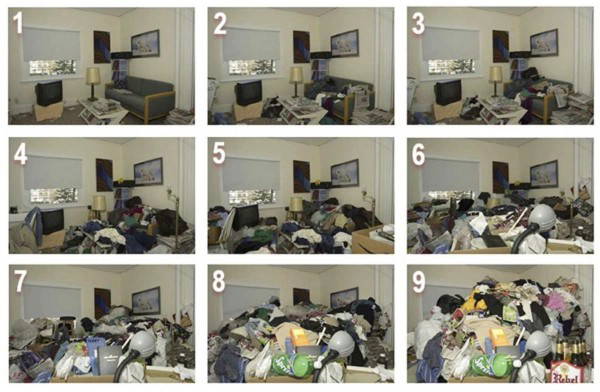
Level 1 Clutter image rating 1 – 3 Household environment is considered standard. No specialised assistance is needed. Ask the customer how they feel they are managing and consider signposting if they feel they are starting to struggle to manage the property. Is the home still appropriate, would they benefit from downsizing, single storey living, or a scheme?
Level 2 Clutter Image Rating 4 – 6 Household environment requires professional assistance to resolve the clutter and the maintenance issues in the property. Ask if family or friends are able to assist. Discuss a referral to Social Services.
Level 3 Clutter image rating 7 – 9 Household environment will require intervention with a collaborative multi-agency approach with the involvement from a wide range of professionals. This level of hoarding constitutes a Safeguarding alert due to the significant risk to health of the customer, surrounding properties and residents.
Appendix B – Action Plan
Action Plan
(To address property condition and hoarding issues identified during inspection and agreed with tenant)
| Which room(s) or areas are affected and how are they affected | What needs to be achieved (agreed action and outcome) | By when and by whom |
| e.g Living room | e.g the rubbish needs to be removed and surfaces cleared. There needs to be a clear pathway through the room. | e.g Ms Smith with assistance from family |